
Anyone can predict a protein structure. The hard part is doing it for every patient, affordably, with an audit trail.
Navi8’s Personalized High-Throughput Compound Side-Effect, Interaction, Repurposing & Alternatives pipeline — PHT-CSEIRA — turns a person’s sequence and their actual medication list into a bounded, cached, provenance-complete set of GPU jobs. That is the system, and it is what we spent the last year building.
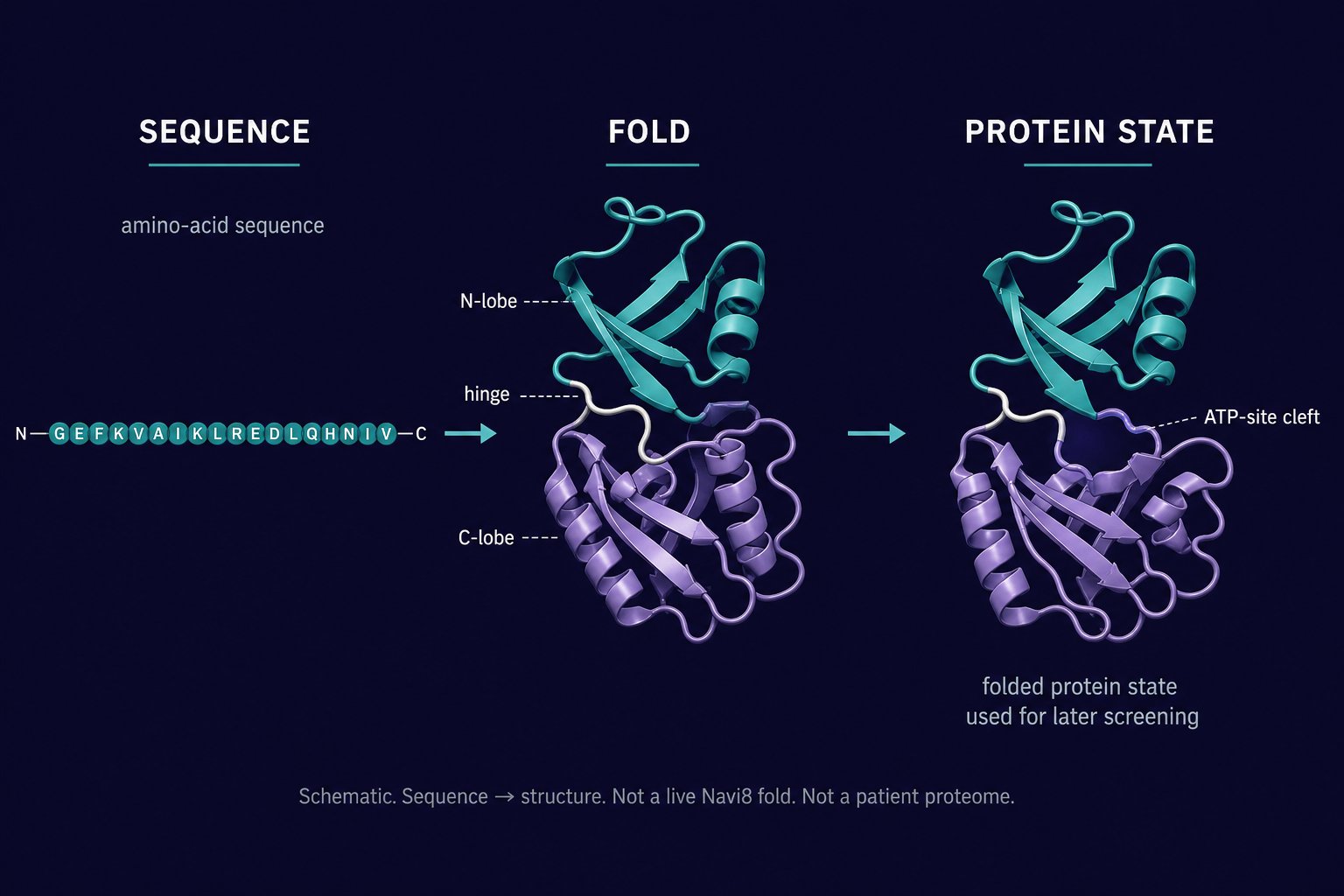
Fold what changed. Nothing else.
Your genome contains millions of variants. Only a small fraction change a protein, and only some of those sit in a protein a medication touches. Navi8’s protein service reads a VCF, computes consequence, collapses variants in the same gene into haplotype states and folds those states — with reference structures and alignments shared across every subject.
- Non-protein-changing variants never trigger compute.
- Multiple rows in one gene collapse to a single haplotype state.
- Structures are keyed on sequence hash and model version — the second person with the same state is free.
Then ask the structure a question.
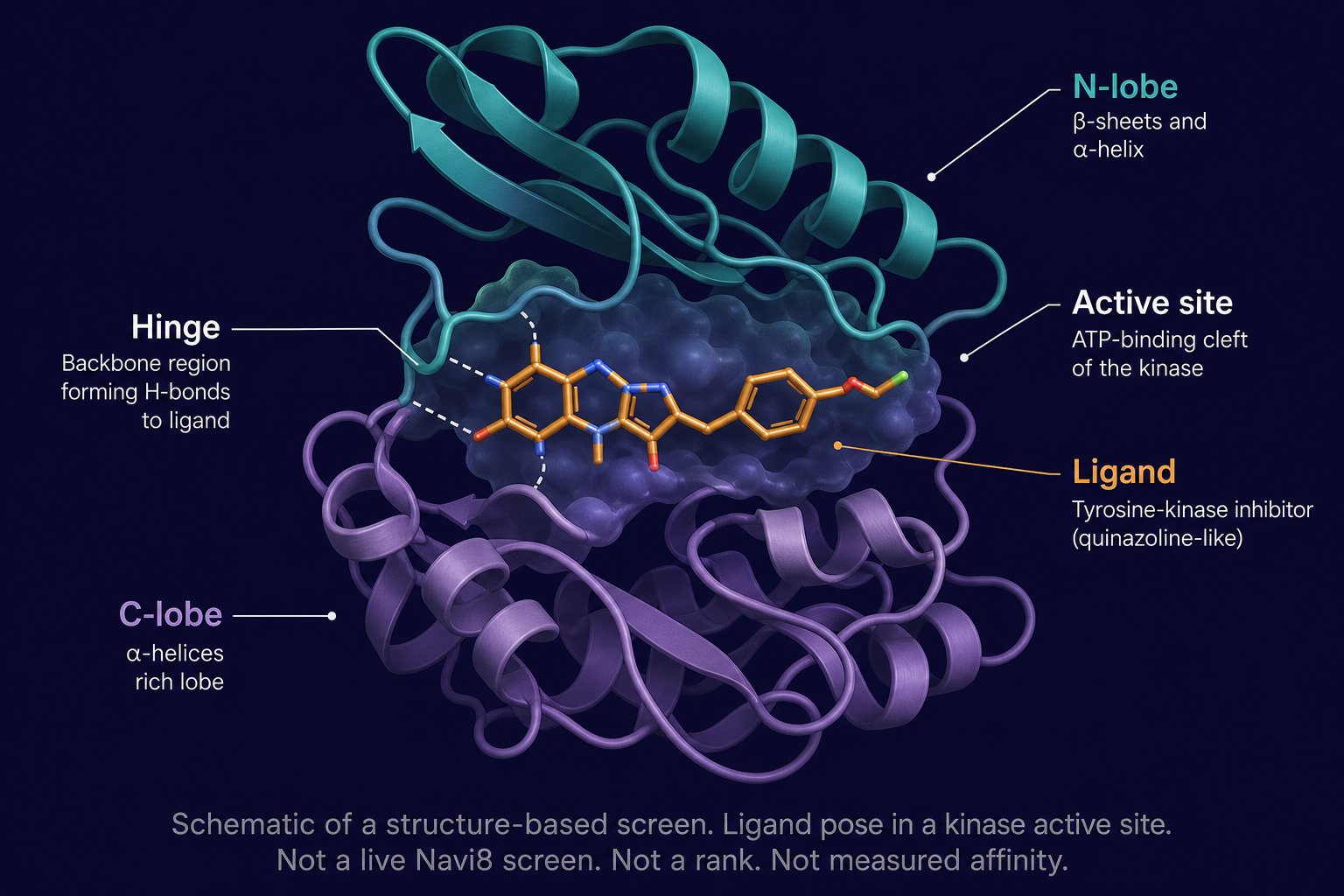
Each medication resolves to a canonical molecule and expands into a compound manifest: same-class members, repurposing candidates that bind the same target, and — where bounded — natural-product candidates. Navi8’s proprietary structure and binding-affinity engine then evaluates each compound against the patient’s protein states, in both a standard mode and a wild-type-versus-variant mode.
- Three job families: side-effect risk rank ordering, multi-drug adverse-reaction analysis, and alternatives.
- Every candidate carries why it exists; every structure carries what produced it.
- Structural signal, clinical evidence and model confidence stay separable all the way to the screen.
Three service boundaries, a dependency-aware job planner, and caching at every layer.
The orchestrator owns the lifecycle, not the domain logic. Domain services produce manifests. The job manager turns manifests into an atomic, cache-keyed job graph. GPU and API tiers are decoupled, so jobs fail, retry and resume independently.
POST /v1/analysesCompact request: subject · 1–10 medications · analysis intents · genomics artifact → returns an analysis id immediatelyRunning on our own GPU cluster today.
These are not benchmarks from a paper. They were measured on Navi8’s internal cluster, and the first subject-specific protein state has been folded from sequence data on that hardware — the step everything else depends on.
- Signed patient-haplotype fold with high structure confidence (pLDDT 0.91, pTM 0.92) on a 327-residue kinase domain.
- Documented-pair smoke test of a known kinase–inhibitor complex reproduced with ligand interface confidence 0.97.
- Capacity model driven by onboarding rate and analysis volume — never a static GPU count.
What Navi8 will not say.
A structural screen is a powerful research signal. It is not a diagnosis. These rules are enforced in the product, not just the marketing.
| Navi8 says | Navi8 never says |
|---|---|
| Same-class alternative — a discovery candidate for a clinician conversation | A replacement for a prescribed treatment |
| Structural risk signal — where a compound sits on your off-target panel | The probability of an adverse event |
| Predicted affinity — a model estimate with a stated confidence | A measured binding constant |
| Natural-product candidate — bounded, screened, sourced | A natural replacement for a medication |
| Protein panel — the states relevant to your medications | Your proteome |
| Pending evidence — when the evidence layer has not returned | “No known interaction” |
Want the technical walkthrough?
Clinicians, partners and investors can request the full PHT-CSEIRA architecture deck and a live demonstration.